
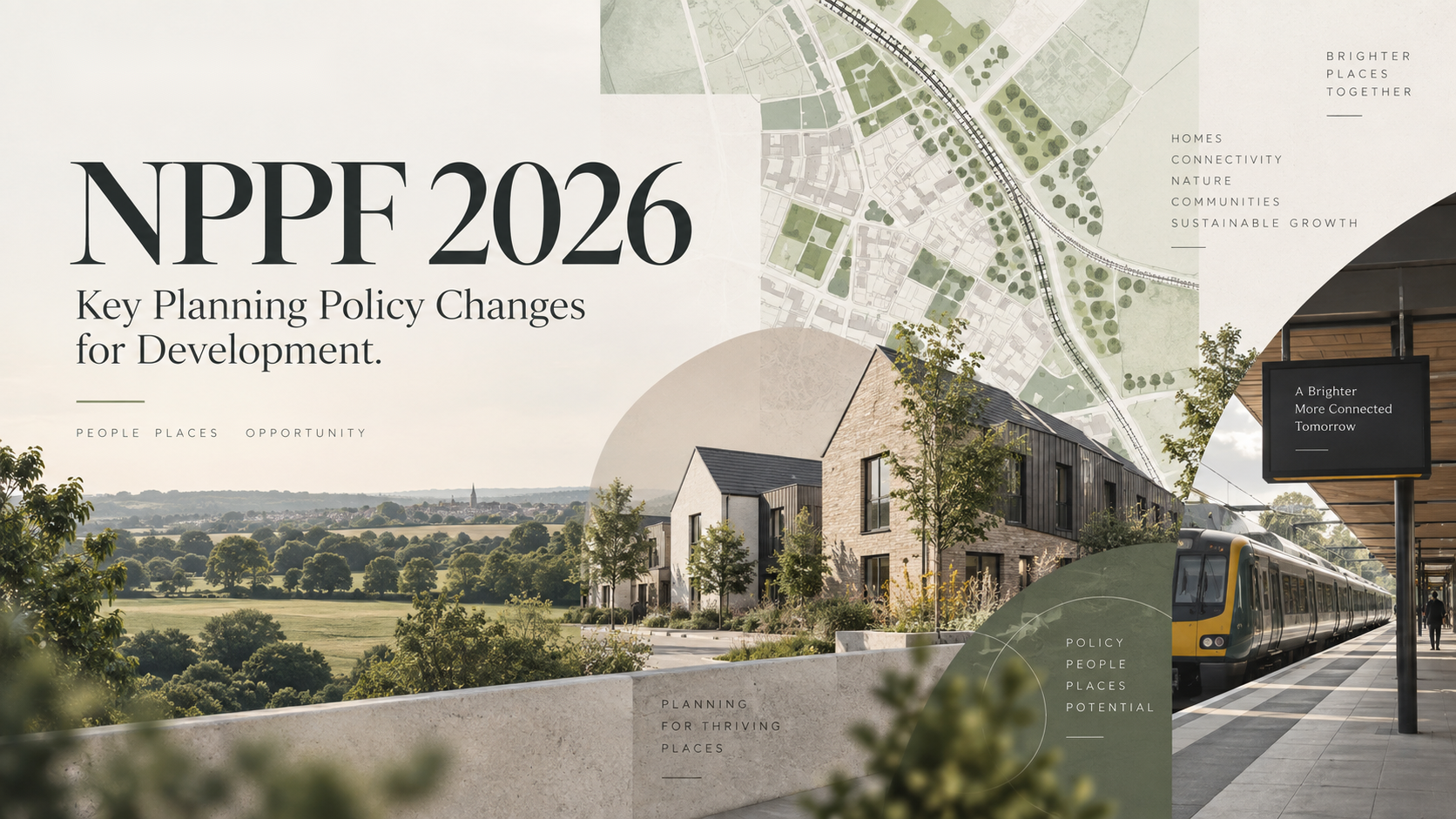
NPPF 2026: What Has Changed and What Does It Mean for Development?
The Government published a new National Planning Policy Framework(NPPF) on 17 August 2026, replacing the previous version published in December 2024.
The NPPF sits at the heart of the planning system in England. It influences how Local Plans are prepared and, importantly, how planning applications are assessed and determined by local authorities.
The 2026 update represents more than a routine revision. The Framework has been substantially restructured, with a greater emphasis on clear national decision-making policies, housing delivery, sustainable locations and providing greater certainty over where development should be supported.
For homeowners, landowners and developers, these changes could create new opportunities, but they also make understanding the planning position of a site at an early stage increasingly important.
A More Rules-Based Planning System
One of the most significant changes is the introduction of a clearer distinction between policies dealing with the preparation of Local Plans and national policies dealing directly with planning decisions.
The new national decision-making policies came into effect immediately on 17 August 2026. Local authorities are also prevented from introducing Local Plan policies which simply duplicate, restate or conflict with these national policies.
Where an existing Local Plan policy is materially inconsistent with then ew national decision-making policies, the Framework indicates that it should be given very limited weight.
In practical terms, national planning policy is therefore likely to have a much more direct influence on individual planning applications.
The aim is to create a planning system which is more consistent across England and provides applicants, councils and communities with greater certainty about how proposals should be assessed.
A Stronger Presumption in Favour of Development
Another important change is the restructuring of the presumption infavour of sustainable development.
Rather than relying as heavily on whether a Local Plan is consideredout of date, the new approach places greater emphasis on where development islocated.
Within defined settlement boundaries, the Framework introduces a stronger presumption in favour of development. Planning permission should generally be granted unless the adverse effects would substantially outweigh the benefits of the proposal.
There are also specific circumstances where development outside settlement boundaries can receive policy support. These include the development of previously developed or brownfield land, limited infilling, the reuse or replacement of existing buildings, development close to well-connected railway stations and proposals which respond to an evidenced unmet need.
This does not mean that planning permission becomes automatic. Design, heritage, landscape, highways, ecology, flooding and neighbouring amenity will all remain important considerations.
What it does mean is that the starting point for assessing whether development is acceptable has changed significantly.
Greater Support for Development Around Railway Stations
The Government has also placed considerable emphasis on directing development towards locations with good public transport connections.
The new NPPF provides additional support for development within a reasonable walking distance of well-connected railway stations, which is generally defined as approximately 800 metres or a ten-minute walk.
It also introduces minimum density expectations around qualifying stations, with the intention of making more effective use of land in accessible locations. The final Framework extends its station-led approach to the top 80 Travel to Work Areas by Gross Value Added.
For London, Essex and other parts of the South East with extensive rail networks, this could become particularly important when considering development opportunities around existing towns and settlements.
Sites previously regarded as relatively constrained because of their location or density may therefore warrant reconsideration against the new policy framework.
Green Belt and Grey Belt Development
Green Belt policy remains an important part of the NPPF, although the approach continues to evolve.
The concept of ‘grey belt’, introduced through the previous changes tonational policy, remains central to the Government's approach to identifyinglower-performing areas of Green Belt which may be suitable for development.
The 2026 NPPF further refines this approach. In particular, where a development plan identifies suitable land around well-connected stations, exceptional circumstances do not necessarily need to be demonstrated to alter Green Belt boundaries.
The Framework also continues to apply the Green Belt ‘Golden Rules’ to qualifying major development, including requirements relating to affordable housing, infrastructure and accessible green space. The ability to depart from these requirements on previously developed Green Belt sites has also been tightened where viability is relied upon.
The result is not a removal of Green Belt protection. Instead, it represents a more selective approach which differentiates between land performing an important Green Belt function and land where sustainable development could potentially be accommodated.
More Emphasis on Making Effective Use of Land
The new Framework also reinforces the Government's objective of making better use of land that is already developed or located within existing settlements.
There is increased support for intensification, additional floorspace and development within existing residential curtilages, alongside the continued strong support for suitable brownfield development.
Local authorities are expected to identify locations where greater intensification can be accommodated rather than automatically relying on outward expansion.
For homeowners and developers, this could support opportunities such as:
- Redevelopment and more efficient use of previously developed sites
- Additional development within larger residential plots
- Increasing the density of suitable sites
- Development around railway stations and transport corridors
- Bringing underused or redundant buildings back into productive use
Whether these opportunities can be realised will still depend heavily on the individual site and its surrounding context.
Housing Delivery and Smaller Development Sites
Housing delivery remains a major focus of national policy.
The 2026 Framework requires local planning authorities to allocate at least 10% of their housing requirement on small sites below one hectare, together with a further 10% on medium-sized sites between one and 2.5 hectares.
It also introduces a clearer category for strategic development sites of around 1,500 homes or more and places additional emphasis on ensuring permitted housing developments are built without unnecessary delay.
For smaller landowners, the continued emphasis on small and medium-sized sites is significant. Development opportunities do not necessarily need to involve large strategic landholdings, and well-located smaller sites will continue to form an important part of meeting local housing requirements.
Design, Heritage and Protected Landscapes Still Matter
While much of the new Framework is aimed at supporting development, this does not mean that design and environmental considerations have been weakened.
The NPPF continues to give significant weight to achieving well-designed development and strengthens parts of the policy relating to heritage and protected landscapes.
Major development within National Parks and National Landscapes should continue to be refused other than in exceptional circumstances. For designated heritage assets, the Framework now makes explicit that any harm to their significance is a matter of considerable importance and weight.
Good design and a clear understanding of context therefore remain fundamental to achieving planning permission, particularly for sites within Conservation Areas, National Landscapes or close to listed buildings.
Changes to Biodiversity Net Gain
There is also an important change to the approach to Biodiversity NetGain (BNG).
While the statutory requirement for 10% BNG remains, the new NPPF limits the circumstances in which councils can impose requirements exceeding 10%.
Higher requirements will generally need to be properly justified through an up-to-date site allocation rather than being imposed through general local policies.
This should help create greater consistency between local authority areas and provide developers with more certainty when assessing the ecological requirements and potential costs associated with a site.
Young & You: Our Thoughts
Perhaps the most important message from the new NPPF is that the planning system is becoming increasingly focused on the location and characteristics of individual sites.
Being within a settlement, close to a well-connected railway station, previously developed, capable of accommodating additional density or able to respond to an identified housing need can now have an important influence on the planning balance.
Equally, heritage, landscape, design, environmental and infrastructureconstraints continue to carry significant weight.
This makes early planning assessment particularly valuable. Before committing significant time and cost to a design or purchasing a potential development site, understanding how the property sits within the new national and local planning policy framework can help identify opportunities, constraints and the most appropriate route forward.
At Young & You, our architectural and Chartered Town Planning expertise allows planning strategy and design to be considered together from the outset. This helps us develop proposals that respond both to what our clients want to achieve and to the planning policy framework against which their project will ultimately be assessed.