
Class MA Office to Residential Conversion London & Essex Guide
A guide to Class MA permitted development and office to residential conversions in London and Essex. Understand eligibility, prior approval, Article 4 Directions and Class E to C3 requirements.
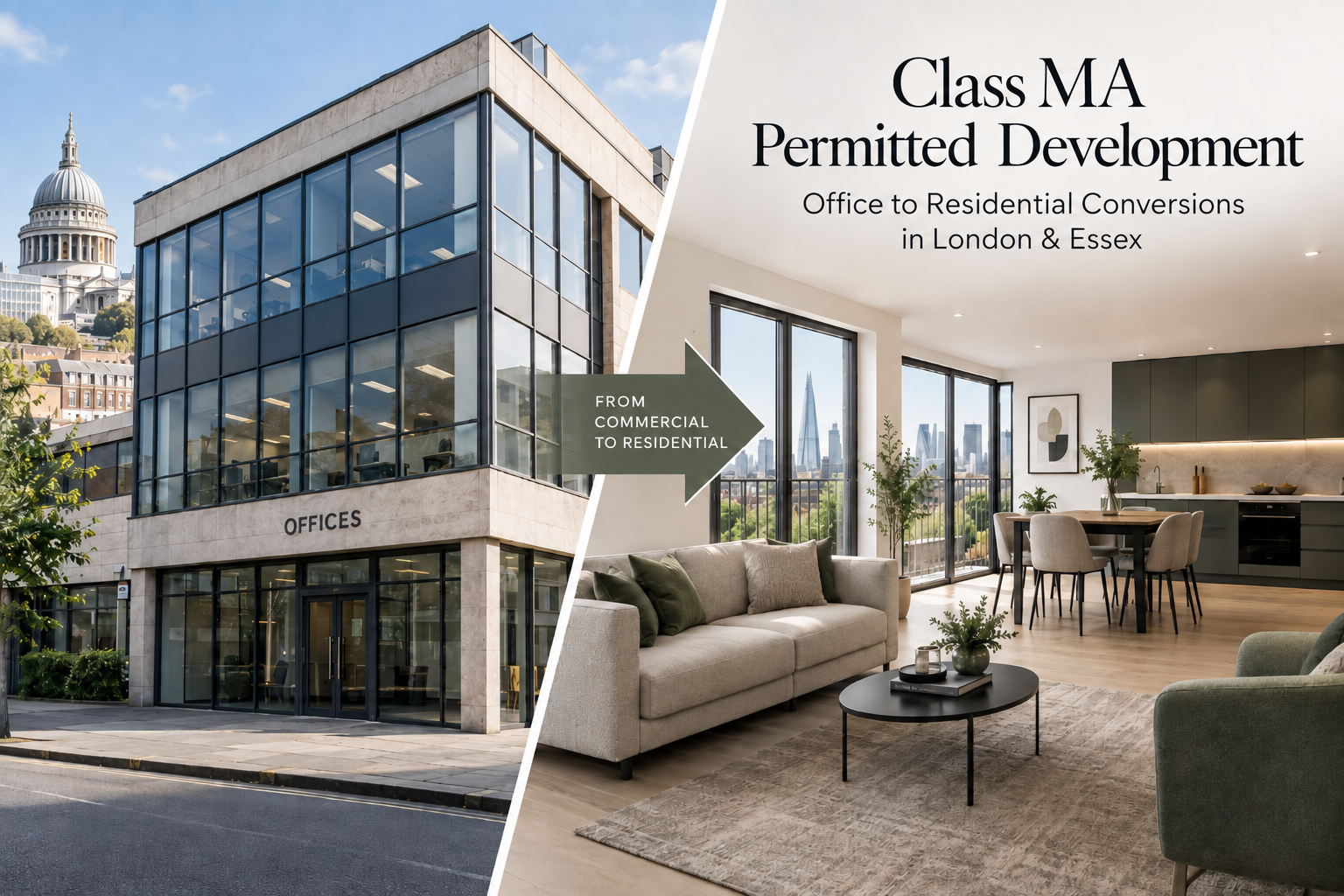
Class MA Permitted Development: Office to Residential Conversions in London & Essex
Class MA permitted development can provide a valuable route for converting offices and other commercial premises into residential accommodation without making a full planning application.
The legislation allows qualifying buildings within Use Class E – Commercial, Business and Service to change to Use Class C3 – Dwellinghouses, subject to meeting the relevant criteria and obtaining prior approval from the local planning authority.
Class MA is particularly relevant to office to residential conversions in London and Essex, where existing offices, shops and other commercial buildings may provide opportunities for residential redevelopment.
However, Class MA should not be considered an automatic or simplified planning route. Before proceeding, the building's existing and historic use, planning history, location, Article 4 restrictions and proposed residential layout all need to be carefully considered.
In Short: What Is Class MA Permitted Development?
Class MA permitted development allows certain Class E commercial buildings to change to residential use without full planning permission.
This can include existing:
- Offices
- Shops
- Restaurants and cafés
- Financial and professional services
- Gyms and indoor recreation uses
- Certain medical and health facilities
- Nurseries and day centres
- Other qualifying Class E uses
The development must satisfy the requirements of Class MA of Part 3, Schedule 2 of the General Permitted Development Order, and a prior approval application must be made to the local planning authority before the change of use takes place.
Importantly, Class MA relates to the change of use of the building. It does not itself provide planning permission for building operations such as significant external alterations, new windows, new doors or extensions. Where these works are required, separate planning permission or another relevant permitted development right may need to be considered.
Can I Convert an Office to Residential Under Class MA?
Potentially, yes.
Office to residential conversion remains one of the most common applications of Class MA. However, the fact that a building is currently used as an office does not automatically mean that it qualifies.
One of the principal requirements is that the building must have been within a qualifying commercial use for a continuous period of at least two years before the date of the prior approval application.
Evidence of the historic use of the building can therefore be important.
Depending on the property, supporting evidence might include:
- Previous planning permissions
- Lawful Development Certificates
- Business rates records
- Lease documentation
- Historic photographs
- Marketing information
- Utility records
- Company or occupier information
Establishing the lawful planning use of the building at the outset can avoid significant problems later in the application process.
What Changed to Class MA in 2024?
Class MA was substantially widened in 2024.
Previously, buildings generally had to have been vacant for a continuous period before an application could be submitted, and there was a 1,500m² floorspace limit on the amount of commercial space that could change use.
Both restrictions were removed.
There is therefore now:
- No requirement for the commercial premises to be vacant before applying
- No Class MA floorspace ceiling limiting the size of the conversion
This means that Class MA can potentially apply to significantly larger commercial buildings and occupied premises, provided that the other qualifying criteria are satisfied.
For owners and developers considering commercial to residential conversion in London or Essex, this has significantly increased the range of buildings that may potentially benefit from Class MA.
What Buildings Qualify for Class MA?
Before preparing a Class MA prior approval application, it is important to undertake an initial eligibility assessment.
A key requirement is that the building must have been within a qualifying Class E use, or relevant predecessor use, for a continuous period of at least two years before the prior approval application is made.
Class MA is also unavailable in certain locations and circumstances.
For example, the right does not apply where the relevant building or land is:
- A listed building or within the curtilage of a listed building
- A scheduled monument or within its curtilage
- Within a Site of Special Scientific Interest
- Within a National Landscape, formerly known as an Area of Outstanding Natural Beauty
- Within a National Park
- Within the Broads
- Within a World Heritage Site
- Within certain safety hazard or military explosives areas
A property may also be prevented from using Class MA where an Article 4 Direction has removed the permitted development right.
This is particularly important for Class MA applications in London.
Class MA and Article 4 Directions in London
One of the most important considerations for any Class MA application in London is whether the building is affected by an Article 4 Direction.
An Article 4 Direction allows a local planning authority to remove specified permitted development rights within a defined area. Where a Class MA Article 4 Direction applies, converting a Class E commercial property to residential may require full planning permission instead of prior approval.
A number of London boroughs have introduced Class MA Article 4 Directions to protect strategically important commercial areas, town centres, employment locations and shopping areas.
The position is highly site-specific. An Article 4 Direction may cover one part of a borough while Class MA remains available elsewhere.
For example, Class MA restrictions are in place across specified areas of boroughs including Islington, Southwark and Hackney, amongst others.
For this reason, one of the first stages when assessing an office to residential conversion in London should be to establish:
- Whether the property falls within an Article 4 Direction
- Exactly which permitted development rights the Direction removes
- Whether the Direction applies to the particular commercial use
- Whether Class MA remains available at the property
This should be confirmed before significant expenditure is incurred developing the residential scheme.
Can Class MA Be Used in a London Conservation Area?
Potentially, yes.
Being within a Conservation Area does not automatically prevent the use of Class MA.
However, where a Class MA proposal involves changing the use of the whole or part of the ground floor of a building within a Conservation Area, the local planning authority can consider the impact of the change of use on the character or sustainability of the Conservation Area as part of the prior approval process.
This can be particularly important in London, where commercial premises frequently form part of traditional shopping streets, historic centres and mixed-use neighbourhoods.
The presence of an Article 4 Direction should also be checked separately, as many commercially important areas of London are subject to additional permitted development controls.
What Does a Class MA Prior Approval Application Assess?
Unlike a full planning application, the local planning authority cannot assess a Class MA proposal against every aspect of its normal planning policies.
Instead, its assessment is focused on specific matters prescribed by the legislation.
Depending on the site and proposal, these include:
- Transport impacts, particularly safe site access
- Contamination risks
- Flood risk
- Noise from existing commercial premises affecting future residents
- Adequate natural light within all habitable rooms
- The impact of residential occupation within areas important for industry, waste management, storage or distribution
- The effect on the character or sustainability of a Conservation Area where the relevant test applies
- The loss of certain registered nursery or health centre services, where applicable
- Fire safety impacts where the development meets the relevant fire risk criteria
The council's assessment is therefore narrower than it would be under a full planning application, but a proposal must still satisfy each relevant Class MA requirement.
Natural Light and Class MA Applications
Natural light is often one of the most important design considerations when converting an office or other commercial building into flats.
The local planning authority must consider whether adequate natural light is provided to all habitable rooms.
Commercial buildings can present challenges because they were not originally designed for residential occupation. Deep floorplates, limited existing windows and internal areas some distance from external walls can make it difficult to create an appropriate residential layout.
The architectural design should therefore be considered alongside the planning strategy from the outset.
Attempting to maximise the number of flats without properly considering window positions, room depths and natural light can undermine an otherwise viable Class MA scheme.
For larger office to residential conversions in London, preparing the proposed layout before progressing too far with the acquisition or development strategy can be particularly important.
Do Class MA Flats Have to Meet Minimum Space Standards?
Yes.
New homes created through permitted development must comply with the applicable Nationally Described Space Standard.
The required minimum internal floor area depends upon factors including:
- The number of bedrooms
- The number of intended occupants
- Whether the accommodation is arranged over one or more storeys
It is therefore not sufficient simply to divide an existing commercial building into the maximum possible number of residential units.
The proposed apartments need to be designed around the relevant minimum space requirements as well as natural light, circulation, access and the practical requirements of residential occupation.
An early architectural feasibility study can be particularly valuable for determining the realistic development capacity of a commercial building.
Noise and Office to Residential Conversions
Noise can be particularly important for Class MA applications in Central London, town centres and mixed commercial areas.
Introducing residential accommodation into a commercial location can expose future occupants to noise from:
- Restaurants and bars
- Commercial plant and machinery
- Servicing and deliveries
- Adjacent businesses
- Entertainment premises
- Industrial activity
- Road and rail traffic
Where commercial noise could affect future residents, an acoustic assessment may be required to demonstrate that appropriate living conditions can be achieved.
This can influence the internal arrangement of apartments, the position of bedrooms and living areas, glazing specifications and ventilation strategy.
Does Class MA Include External Alterations?
Not automatically.
This is an important distinction that is sometimes overlooked.
Class MA provides permitted development rights for the change of use from Class E to Class C3. It does not provide a general right to undertake building operations required to convert the premises.
Works such as:
- Installing new windows
- Changing existing window openings
- Adding new external doors
- Altering shopfronts
- Changing the external appearance of the building
- Constructing extensions
may therefore require a separate planning application.
This can be particularly important for office conversions where additional windows are needed to achieve suitable natural light.
The planning strategy should therefore consider both the Class MA change of use and any associated external works before an application is submitted.
How Long Does a Class MA Prior Approval Application Take?
The Class MA prior approval procedure operates within a 56-day determination period.
The local planning authority must consider the application within the framework established by the General Permitted Development Order.
A comprehensive submission is important because missing information, uncertainty regarding the lawful use of the building or insufficient technical evidence can make it more difficult to demonstrate compliance within the statutory timeframe.
Where prior approval is granted, the Class MA development must normally be completed within three years of the prior approval date.
Common Class MA Planning Issues
Some of the most common issues we identify when reviewing potential Class MA developments include:
- Failing to establish the building's lawful commercial use
- Insufficient evidence of the qualifying two-year use period
- An overlooked Article 4 Direction
- Assuming Conservation Areas automatically prevent Class MA
- Attempting to use Class MA for a listed building
- Residential units that do not meet minimum space standards
- Bedrooms or living rooms with inadequate natural light
- Noise from adjoining commercial premises
- Flood risk requiring further technical assessment
- External alterations incorrectly included as part of the Class MA application
- Designing the residential layout before checking whether Class MA applies
Undertaking an initial planning and architectural feasibility assessment can identify many of these issues before a full prior approval package is prepared.
Class MA Applications in London
Class MA can create significant opportunities for the reuse of commercial buildings across London, but the planning position can be more complex than elsewhere.
This is particularly the case in areas containing:
- Major town centres
- Established office locations
- Protected shopping frontages
- Strategic employment areas
- Conservation Areas
- Mixed commercial and industrial districts
Article 4 Directions are particularly important and should be checked on a property-by-property basis.
For developers considering an office to residential conversion in London, early planning due diligence can establish whether Class MA is available before progressing with detailed architectural design or a property acquisition.
This can be particularly valuable when assessing development opportunities across Central London, North London, East London and the outer London boroughs.
Class MA Applications in Essex
Class MA can also provide opportunities for the conversion of commercial premises across Essex, particularly within established town centres and locations where the demand for commercial floorspace has changed.
Young & You advise on Class MA and commercial to residential projects across Essex, including areas such as:
- Colchester
- Chelmsford
- Brentwood
- Braintree
- Epping
- Tendring
- Uttlesford
As with London, every property requires an individual assessment of its lawful use, planning history, physical characteristics and local planning restrictions before relying on permitted development rights.
Is Class MA Better Than Full Planning Permission?
The most appropriate route depends on the property and the development being proposed.
Class MA can provide significant advantages because the principle of changing a qualifying Class E building to residential is established through national permitted development rights. The council's assessment is limited to the matters specified within the legislation rather than the full range of planning considerations that would apply to a conventional planning application.
However, Class MA is not always the best route.
A full planning application may be preferable where:
- An Article 4 Direction prevents Class MA
- Significant external alterations are required
- The building does not satisfy the qualifying criteria
- The proposed development forms part of a wider redevelopment
- Greater flexibility is required over the design or use of the site
Comparing both routes at an early stage can help establish the most appropriate planning strategy.
Considering an Office to Residential Conversion?
Class MA can offer a valuable route for converting qualifying commercial buildings into residential accommodation, particularly where the existing building lends itself well to residential conversion.
However, successful Class MA applications require more than simply demonstrating that a building was previously used as an office or shop.
The planning history, qualifying use, Article 4 position, residential layout, natural light, noise environment, space standards and any required external alterations should all be considered before submitting an application.
For commercial property owners and developers in London and Essex, undertaking this assessment early can help determine both whether Class MA is available and the realistic residential potential of the building.
How Can Young & You Help?
Young & You provides architectural and town planning consultancy services for Class MA and office to residential conversions across London and Essex.
Our combined architectural and planning approach means we can assess both the planning eligibility of a building and its practical potential for residential conversion.
Our services can include:
- Class MA planning feasibility assessments
- Planning history and lawful use reviews
- Article 4 Direction checks
- Architectural feasibility studies
- Residential layout design
- Existing and proposed drawings
- Review of Nationally Described Space Standards
- Coordination of noise, flood risk and other specialist assessments
- Preparation of Class MA supporting statements
- Submission of the prior approval application
- Management of the application through to determination
- Advice on separate planning applications for external alterations
Whether you are considering a single office to residential conversion or assessing the development potential of a larger commercial building, early planning and architectural advice can help establish the most appropriate route before progressing with the project.
Need help with your office to residential project? Get in touch to discuss your proposal and how we can help.